Survivor Tax Planner
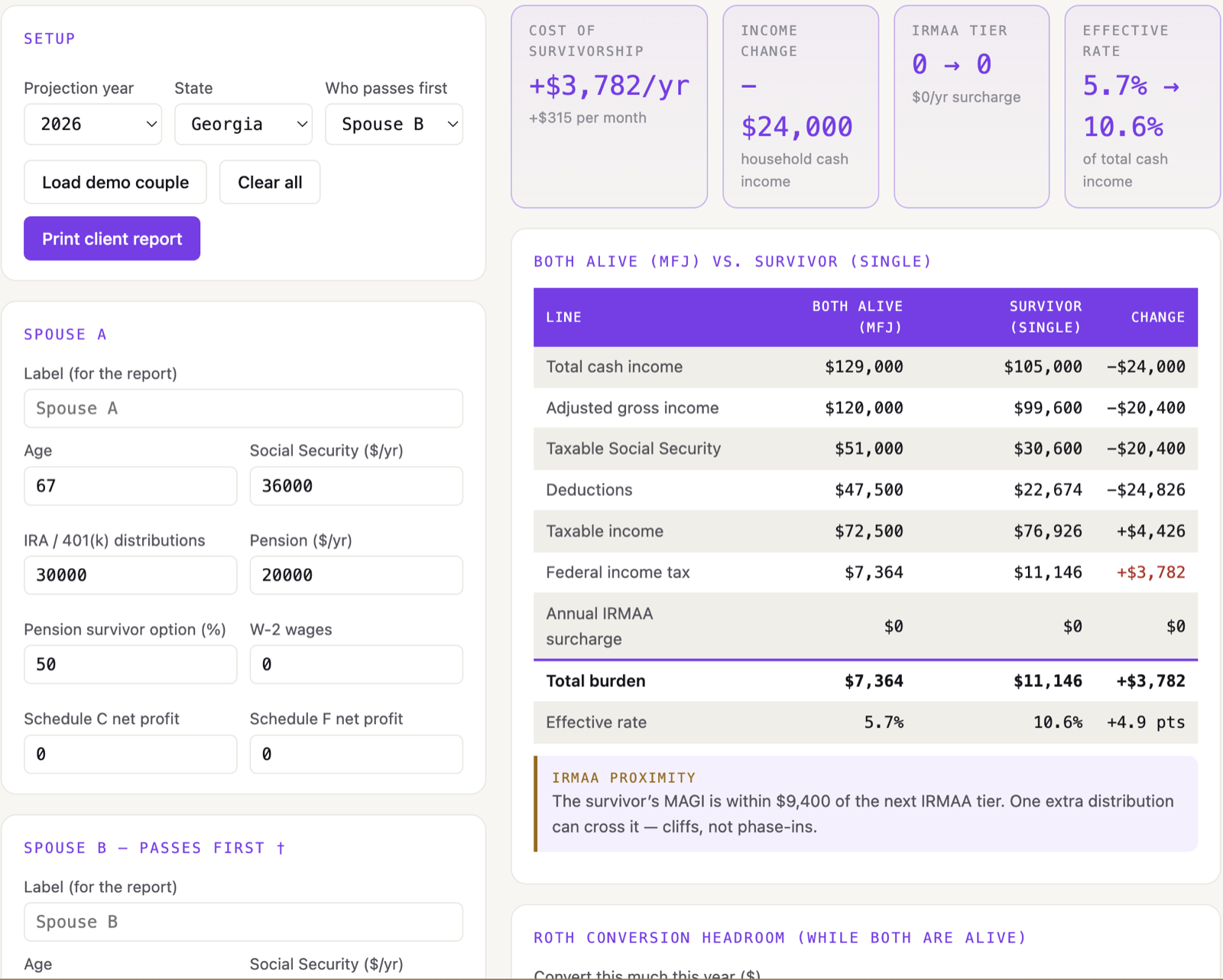
The widow's penalty, made visible before it arrives. Enter one household's income picture and see the same year twice: both spouses alive filing jointly, and the survivor filing Single. It puts an annual and a monthly number on the cost of survivorship, flags the Medicare IRMAA cliffs, sizes Roth-conversion headroom while both spouses are alive, and prints a one-page report you can hand the client.
One file. Nothing leaves the machine.
The whole planner is a single HTML file. Every calculation runs in your browser: no server, no account, no install, and zero network requests, which you can verify in your browser's developer tools. That is why it is safe for real client numbers on day one.
Download it, double-click it, done. It opens pre-loaded with a generic demo couple so it never starts blank, and it works with the WiFi off. For client work, keep the filled copy in that client's folder like any other workpaper.
How to run a client in three steps
- Enter the couple. Per-spouse Social Security, IRA and 401(k) distributions, pension with its survivor option, W-2 wages, and Schedule C or F income; joint interest, dividends, capital gains, and rental. Pick who passes first and the state (Georgia, or a no-income-tax state like FL or TX).
- Read the comparison. The side-by-side shows both returns line by line, and the callouts flag what changed: IRMAA tier jumps and near-misses, the 0.9% Additional Medicare threshold, QBI limits engaging, and which of the decedent's income actually stops.
- Print the client report. One page: the comparison, the key assumptions in plain English, and a "Prepared by" line with your name on it. Print to PDF or paper. That is the deliverable.
What it models
- Taxable Social Security worksheet (IRC §86)
- Ordinary brackets plus LTCG stacking
- Medicare IRMAA tiers, with cliff warnings
- Net investment income tax (§1411)
- Self-employment tax and the 0.9% Additional Medicare tax
- §199A QBI, including SSTB and W-2/UBIA limits
- The OBBBA senior deduction and its phase-out
- Per-spouse attribution: earned income stops with the earner, the survivor keeps the larger Social Security benefit, pensions continue at their survivor percentage
- Georgia's flat tax and retirement exclusion, or no-tax states
- Roth-conversion headroom while both spouses are alive
Not modeled: AMT, qualifying surviving spouse status, QBI loss carryovers, and multi-business QBI detail. K-1s work by decomposing them into their components for now; a dedicated K-1 input is on the list.
Every number, cited
Every rate and threshold in the planner traces to primary source. This is the full list, so you can defend relying on it:
| Figure | Authority |
|---|---|
| 2026 brackets, standard deduction, LTCG breakpoints | Rev. Proc. 2025-32 |
| Additional standard deduction, 65 and older ($2,050 single / $1,650 per spouse MFJ) | Rev. Proc. 2025-32 |
| Senior deduction: $6,000 per person 65+, 2025 through 2028, phased out at 6% of MAGI over $75,000 / $150,000 | OBBBA (P.L. 119-21) §70103 |
| Social Security taxability thresholds ($25,000 / $34,000 single; $32,000 / $44,000 MFJ) | IRC §86 (statutory, not indexed) |
| Net investment income tax: 3.8% over $200,000 single / $250,000 MFJ | IRC §1411 (statutory, not indexed) |
| Self-employment tax: 15.3% on 92.35% of net earnings; 2026 wage base $184,500 | IRC §§1401-1402; SSA 2026 COLA release |
| Additional Medicare tax: 0.9% over $200,000 single / $250,000 MFJ | IRC §1401(b)(2) |
| QBI deduction: 20%, permanent; 2026 thresholds $201,750 single / $403,500 MFJ; $400 minimum | IRC §199A; OBBBA §70105; Rev. Proc. 2025-32 §4.26; §199A(i) |
| QBI W-2/UBIA limits and SSTB rules | IRC §199A(b)(2)(B), (d)(2); Treas. Reg. §1.199A-5 |
| Medicare Part B standard premium $202.90/mo and 2026 IRMAA tiers (2-year MAGI lookback) | CMS 2026 premium release (Nov. 2025) |
| Georgia: 4.99% flat rate; retirement exclusion $65,000 (65+) / $35,000 (62-64); standard deduction $12,000 / $24,000; Social Security fully excluded | GA HB 463 (2026); HB 1437 |
How we know the math is right
- The in-browser engine is a line-for-line port of a Python oracle that replays the IRS worksheets. A parity grid holds the two engines to within one dollar across more than a thousand checks, on top of the oracle's own test suite.
- The core engine (the retiree scenario set) was validated against a professionally prepared TY2025 return in Intuit ProConnect to an exact match on every line. The later additions (self-employment tax, QBI) are anchored to published, accountant-reviewed worked examples instead.
- Every copy re-verifies itself each time you open it: the self-check card at the bottom recomputes four fixed households (96 checks, spanning SE tax, QBI, NIIT, IRMAA, and the state layer) against values the oracle computed at build time. If it does not say ALL CHECKS PASS in green, do not rely on that copy.
Two known artifacts: filed returns under $100,000 of taxable income use the IRS tax tables, so professional software can differ by a few dollars by design, and ProConnect suppresses the senior deduction when a return lacks a valid SSN.
Version and updates
Current version: 2.0, built July 2026, covering tax years 2026 and 2025. The rates refresh when the IRS publishes each year's revenue procedure in the fall; re-download then to stay current. The version note is in the file itself, so you can always tell which year's law a copy carries.
This tool started as a request from a CPA planning for a new widower and grew from her field-testing on real cases. If it does not handle your fact pattern, say so in the community: member requests are what drive each version.
A planning illustration, not tax advice, a return, or a substitute for one. Like everything here, it is an educational resource: verify against primary source and your own state's rules, and remember the licensed practitioner reviews, decides, and signs.